
Bat Survey and Mitigation
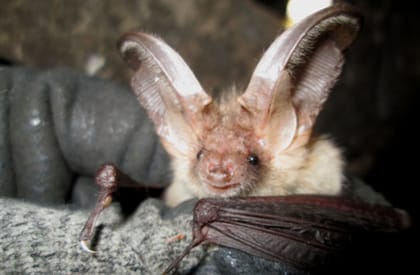
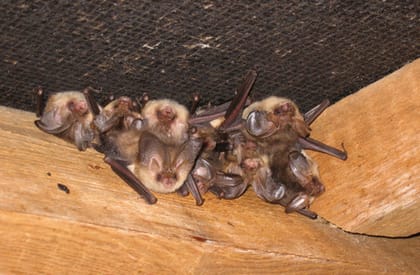
Our licensed bat ecologists provide building, tree and activity surveys, mitigation design and licensing for projects affecting bats and their roosts.
All British bat species and their breeding sites and resting places receive legal protection. This protection applies whether bats are present at the time of the works or not.
Bat surveys may be required where proposals could affect buildings, structures, trees, underground sites, woodland, hedgerows, watercourses or other habitats used by bats.
Richard Green Ecology has nationally recognised experience in bat ecology and can provide support from initial survey through to mitigation, licensing and monitoring.
Buildings and structures
A preliminary roost assessment examines a building or structure for:
- Evidence of bats
- Potential roost features
- Access points
- Internal and external roosting opportunities
- Constraints affecting further survey
Depending on the findings and proposed works, further assessment may include dusk emergence surveys, dawn surveys, automated monitoring, further internal inspection or advanced survey techniques.
Night-vision aids are used for dusk emergence and dawn surveys to increase survey accuracy and provide a reviewable record of bat behaviour.
Tree surveys
Our tree services include:
- Ground-level tree assessment
- Identification and categorisation of potential roost features
- Aerial inspection by appropriately trained and licensed surveyors
- Emergence survey
- Soft-felling and ecological supervision where appropriate
The necessary approach depends on the features present, tree safety, access and the likely effects of the works.
Bat activity and landscape surveys
We undertake nigh-time bat walkover (NBW) activity surveys and static-detector monitoring to assess the use of habitats by commuting and foraging bats.
Survey design is tailored to the site and may include:
- Walked transects
- Fixed-point observations
- Automated static detectors
- Night-vision monitoring
- Roost characterisation
- Swarming or hibernation surveys
- Sound analysis and manual verification
Automated identification software can support analysis but does not replace appropriate quality control and professional interpretation.
Mitigation and licensing
Where a roost could be affected, we first seek to avoid or reduce the impact through design and working methods.
Where licensing is required, we can:
- Design mitigation and compensation
- Prepare licence applications
- Use an appropriate class or Bat Earned Recognition route
- Provide ecological supervision
- Undertake capture and exclusion where authorised
- Complete post-construction monitoring
- Submit required licence returns
The Chartered Institute of Ecology and Environmental Management has produced guidelines for homeowners on what to expect from a bat survey.
Richard Green is one of a relatively small number of consultants in England registered under Bat Earned Recognition (BER – to accreditation level 3) and Bat Mitigation Class Licences (WML-CL21; CL39 & CL40) for England and HS2 (previously known as Bat Low Impact Class Licence – BLICL).
We can therefore offer a more competitive package for bat surveys and licensing. We can also apply for a licence if another consultant has undertaken surveys.
Key Benefits of Service
- Nationally recognised expertise
- Building, structure, tree and activity surveys
- Use of appropriate technology, including full-spectrum GPS bat detector recorders, endoscopes/micro-inspection cameras, thermal imaging and infra-red night vision cameras
- Practical mitigation and compensation design
- Individual, class and Earned Recognition licensing support
- Certificates in tree-climbing and confined space entry
- Survey through to monitoring and licence completion