


Badger Survey and Mitigation
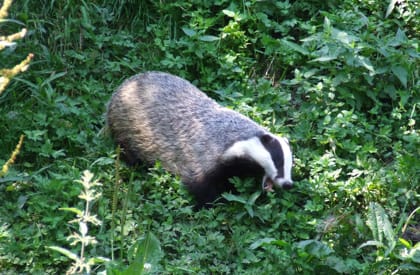
We undertake badger surveys, sett monitoring and mitigation and provide licensing support for projects that could affect badgers or their setts.
Badgers and their setts are protected by law. It can be an offence to kill, injure or take a badger, or to damage, destroy, obstruct or disturb a badger sett without an appropriate licence.
An initial badger assessment can often be undertaken as part of a Preliminary Ecological Appraisal. More detailed work may be required where setts or significant field signs are found or where the status of a sett is uncertain.
Badger survey
Our surveys may record:
- Sett entrances
- Evidence of current use
- Latrines and dung pits
- Paths and runs
- Footprints and hairs
- Foraging signs
- Bedding and spoil
- Potential barriers and crossing points
Sett locations and relevant evidence are recorded using GIS. Sensitive information can be presented confidentially where appropriate.
Monitoring sett use
Remote cameras, tracking methods and repeat inspections may be used where it is necessary to determine:
- Whether a sett is in current use
- Patterns of activity
- Likely sett status
- Appropriate timing for works
- Whether a proposed mitigation measure is effective
The amount of monitoring needed is determined by the project and the information required.
Bait-marking surveys
Bait-marking surveys can be used to investigate relationships between setts and help identify the territories occupied by different badger social groups. Small, distinctively coloured markers are mixed with suitable bait and placed at selected setts. The markers are subsequently searched for in latrines and dung pits across the survey area.
This technique can be particularly useful where a project affects several setts, where the status or territorial relationship of setts is unclear, or where information is needed to inform sett closure, artificial-sett provision or major infrastructure design.
Bait marking normally requires repeated visits over several weeks and is used selectively where the additional information is necessary and proportionate. Its suitability depends on the time of year, the extent of the survey area, access and the availability of suitable latrines and other monitoring locations.
Avoidance, mitigation and licensing
Avoiding impacts through appropriate design and working distances is normally the preferred approach.
Where interference with a sett cannot be avoided, we can advise on:
- Construction buffers
- Timing restrictions
- Sensitive working methods
- Temporary or permanent exclusion
- Sett closure
- Artificial-sett requirements
- Ecological supervision
- Natural England licence applications
- Registration under CL35 where eligible
An artificial sett is not automatically required whenever a sett is closed. The need for compensation depends on sett status, territorial context, alternative sett availability and the nature of the impact.
Key Benefits of Service
- Experienced badger surveyors
- Remote-camera monitoring and bait-marking surveys where required
- Practical design and construction advice
- Individual and CL35 class-licence support
- Exclusion, closure and supervision
- Project-specific artificial-sett advice